I'm cruising on the river of life, happy to trust the flow, enjoying the ride as I live into life as the Rector at Emmanuel Episcopal Church in Webster Groves, MO. I am also co-founder of the Partnership for Renewal, a church vitality nonprofit. You are most welcome to visit my blog anytime and enjoy the ride with me. Peace.
Sunday, June 25, 2023
4 Pentecost, 2023-A: Congruent with Jesus
Thursday, June 1, 2023
Trinity Sunday & Baptism, 2023-A: In the image of God
Lectionary: Genesis 1:1-2:4a; Canticle 2 (Rite I) and Canticle 13 (Rite II); 2 Corinthians 13:11-13; Matthew 28:16-20
En el nombre del Dios que es Trinidad en unidad. Amen.
It’s a wonderfully complicated day today. We gather to celebrate the baptism of Maeve Nash, welcoming
her into the Christian family. It’s Trinity Sunday, the day we ponder the mystery of God who is Trinity in Unity. It’s #wearorgange Sunday, complete with a march at noon to end gun violence as we remember those who lost their lives to it. And it’s the first Sunday in PRIDE Month.As only God can do, our lectionary today is perfect. We begin with the story of creation from Genesis 1. God created and created and created like a mad artist; each creation leading to another burst of creative love revealing yet another dimension of the nature and character of God.
The creation story culminates with God’s creation of humankind… “in the image of God” they were created, male and female. While all of creation is infused with the breath of God’s creative love, only humans are created in God’s own image, and more than that, we are given responsibility to care for the rest of creation.
Please don’t let the phrase “have dominion over” trip you up. It can and does mean rule over, but it also means “noble.” God made humans noble in relation to all other creation. To be noble is to have higher moral principles and ideals.
Dominion is not the same as dominance. Dominion is relational. Dominance is hierarchical. Dominion is other-centered. Dominance is self-centered.
God did not make us the most important or powerful among the created. They made us the most trusted. God chooses us to care for creation in the image of God who created, sustains, and blesses all of creation out of love.While we’re at it, there are two more phrases in our gospel text to clarify. The first is: “Go, therefore, and make disciples.” We had a lively discussion about this at our Bible study this past week. It’s the word translated as “make” that has led to so much coercive action by churches that may or may not have been trying to do the right thing. The problem is the word isn’t “make” – it’s “teach” (literally). Teach others to be disciples.
That’s exactly what we are going to promise to do for Maeve as we baptize her. We’ll promise to teach her – as her community of faith – to be a disciple of Jesus.
The second is the word translated as “obey.” Baptize them, Jesus says, in the name of the Trinity, and teach them to obey everything that I have commanded you. The word “obey” has also led many in the church to focus on enforcing compliance with rules, which is sad, because what Jesus actually said here is better translated as “observe, keep, maintain.”
So, the question is, observe, keep, maintain what? What did Jesus command? The answer is simple and is becoming about the only thing in my sermons lately – Jesus commanded us to love.Love God with all our hearts, minds, and souls. Love our neighbor as ourselves. Love one another as heloved us. Love our enemies. Love - in all its many, complicated forms. When we gather to worship and share Holy Communion, we reconnect ourselves to God and to one another, because answering Jesus’ command to love isn’t easy. In fact, it often seems impossible.
Every day we hear of another shooting somewhere in our country. Every day.
Gun violence is now the leading cause of death for our children. Our culture has politicized this so much that it’s become nearly impossible to have reasonable discussions about it – but we must, and church is where those difficult discussions have to happen, because church is where the love of God has dominion in our hearts.
Church is where the sacrament of the body and blood of Christ unites us into one body, one spirit. It’s where we recognize that the only true power is the power of God and that power is the power of love. Church is where we greet one another with a holy kiss – something only family did in St. Paul’s time.
We are the family of God in Christ in this time and place in the world. We baptize people and teach them how to love as Jesus commanded us to do, remembering that no matter how impossible or horrible the world seems at any moment of our experience, it is a beloved creation born of God’s love and it is our responsibility to care for it, to restore it to peace and unity, and to teach others to do the same.
I once served a church that held the first PRIDE event in that deep southern town – about 15 years ago. It was a picnic, a PRIDE picnic. We invited the local gay community as well as supportive groups like PFLAG to come and share information on how to be supportive allies. We grilled food, painted faces, and played games.You can see why this was so threatening. Yet apparently it was. Protestors from Westboro Baptist Church and some other local church groups showed up to scream condemnation at us using foul language – in front of the children. Horrible words were graffitied onto our church doors and walls with black paint. They tried to disrupt our worship the next morning with a bullhorn screaming derogatory names and accusations at our faith community.
Is this how they interpret Jesus’ command to love? It didn’t feel a bit like love. It felt very much like hate.
Our LGBTQIA+ siblings in Christ are currently under attack. They are not being loved as Christ commanded, and tragically, it is most often by those who identify themselves as followers of Jesus, as holders of higher moral principles and ideals. They delude themselves.
We are witnesses of their terrorizing and dehumanizing of God’s beloved children, and as witnesses, we must call out what we see as hate, not love. We, the church, have a responsibility to love – and to teach others to do the same - in the name of God who created us all, in the name of Jesus who redeemed us all,and in the name of the Spirit who sanctifies us all.Today, as we sacramentally welcome the newest member of the Christian family, we will also renew our own Baptismal vows – vows that call us to worship together, to seek Christ in ALL others, to love and respect their dignity as fellow nobles, all of us caring for God’s creation.
These are not vows we take lightly. They are our signposts, our guides on how to live as Christians, how to love as Christians in the world as it is.
It won’t be easy. Hate is strong, but love is stronger, and Jesus promised to be with us always – to the end of the “breathing of breath,” the end of human life. While we have life, we have Jesus; and having Jesus means having the wholeness of the Trinity.
Let us pray… Spirit of the Living God, who dwells in our noble human bodies, fill us to overflowing with your divine love, so that the world in which we stand is continually nourished by your living water. Open our hearts and minds, that we may keep your command to us to love. Give us courage to call out hate and restore relationship as we go, teach, and baptize in your name, that your peace may heal our troubled and broken world. Keep us connected to you and to one another, now and always. Amen.
Sunday, May 21, 2023
Ascension, 2023-A: Shedding our spiritual training wheels
Note: The sermon acutally delivered was a little different. It can be viewed on the Emmanuel Episcopal Church Webster Goves YouTube channel at 39 mins 20 seconds.
En el nombre del Dios: creador, redentor, y santificador. Amen.
all who believe. Think about how many people that is and how many riches they represent.
Sunday, May 14, 2023
6 Easter, 2023-A: The wormhole of spiritual understanding
(Note: there is no pre-recorded video of this sermon since I was out of town at my father's funeral this week. The sermon can be watched on the Emmanuel Episcopal Church, Webster Groves YouTube channel)
En el nombre del Dios: creador, redentor, y santificador. Amen.“I desired in many ways to know what was our Lord's meaning. And fifteen years after and more, I was answered in spiritual understanding, and it was said: What, do you wish to know your Lord's meaning in this thing? Know it well, love was his meaning. Who reveals it to you? Love. What did he reveal to you? Love. Why does he reveal it to you? For love. Remain in this, and you will know more of the same.”
Sunday, April 30, 2023
4 Easter, 2023-A: On being sheep and shepherds
Lectionary: Acts 2:42-47; Psalm 23; 1 Peter 2:19-25; John 10:1-10
En el nombre del Dios que es Trinidad en unidad. Amen. (Note: At the Rite II service, the preacher brings the children up for the demonstration…)
Sunday, April 23, 2023
3 Easter, 2023: Inspired with hearts ready to serve
Lectionary: Acts 2:14a,36-41; Psalm 116:1-3, 10-17; 1 Peter 1:17-23; Luke 24:13-35
I love this lectionary today. It is so full of inspiration and heart – and I use those terms intentionally because to be inspired is to be roused or urged to do or know something. Inspiration is something that comes to us from outside us but it is also an internal physical process. To inspire is to breathe in. To be inspired is to be breathed into. For us, it is God who inspires us, who breathes into us, compelling us to live, do, or understand something.
In modern culture, the heart is the seat of love and compassion. For those in Jesus’ time and place, however, the heart was the center and seat of thoughts. It was also considered the location of the soul. In other words, it is the place in our bodies where heaven and earth intersect.So when Jesus laments that the disciples on the road to Emmaus are slow of heart, he isn’t talking about them being slow to love, but slow to understand. So, he explains the Scriptures to them, beginning with Moses, interpreting everything everyone had said about the Messiah.
They still didn’t get it though, and it wasn’t because they were stupid or resistant. It was because it wasn’t time yet. They weren’t ready.
You see, it is God in Christ who acts to open our spiritual eyes and each of us is approached differently. Mary Magdalene’s moment of inspiration happened when Jesus spoke her name. Thomas was inspired when Jesus offered to let him touch his crucifixion wounds. God always meets us where we are and inspires us to move from unbelief to belief - in God's time.
When that happens we recognize and connect with God on a deep, interior level. In the midst of the beauty and glory of this personal connection, we experience a physical sensation, the first sign of the process of transformation happening within us and it happens in that physical spot in our bodies where heaven and earth intersect – in our hearts.
Our Scriptures, Old and New, show us that God has always done it this way. In Ezekiel, God says, “I will give you a new heart, and a new spirit I will put within you.” (36:26). In Jeremiah: “I will put my law within them, and I will write it ton their hearts.’” (31:33) This is what the disciples were experiencing when they said, “Were not our hearts burning within us while he was opening the Scriptures to us?”The heart is where we co-exist, co-abide with God. It is a physical and spiritual reality that is made available for us to strengthen at every sharing of the Holy Eucharist. In the holy food of communion, we become one with the ultimate community, the community of the Divine Trinity. Jesus, the 2nd person of the Trinity, abides in us as we abide in him, making us the current locations of the coexistence of the human and the divine on earth.
The world tends to dismember us, to cut us off from God and one other. When that happens, we experience heartache. We all know how it feels to physically droop and spiritually sag under the weight of the turmoil in our world. As the psalmist says so well, “...the cords of death entangle me, the grip of the grave took hold of me. I came to grief and sorrow.”
That’s been my experience watching the news this week. As I learned about Ralph Yarl, a bright, beautiful 16-year-old in Kansas City who rang the wrong doorbell and got shot for it and now struggles to live, and 20-year-old Kaylin Gillis, who was shot and killed when the car she was in went up the wrong driveway, I felt my heart break and my spirit sag. And these weren't the only innocent lives lost this week to guns.
Listening to the discussions about why some believe that everyone needs unlimited access to a gun and the legal right to “stand their ground,” my heart broke even more. How divided, how dismembered we have become.
God save us, I thought. Show us the way to go.
I’m grateful that preparing this sermon this week I was blessed to be reminded by the psalmist that God
hears the voice of our supplication. It enabled me to repent from my sadness and distress and return to the Lord, putting my trust once again in God’s love and loving plan for us.
That’s why the risen Christ gave us a way to re-member ourselves, to put ourselves back together, to co-exist with God and one another in shalom. Every Sunday when we gather to worship, we intentionally breathe in the Spirit of God through our Scriptures, common prayers, and hymns of praise. We nourish and strengthen our souls with the holy food of Communion. Then we are made ready to breathe out the effects of this in our lives when we are dismissed at the end of our worship service to go in peace to love and serve the Lord.
If we don’t keep breathing it in, however, we can’t keep breathing it out. Coming to Sunday worship is not a duty (social or otherwise), and we don’t affect our eternal outcome by going or not going, but we do affect our present – understanding who we are, whose we are, and what our purpose is.
Being present at the Holy Eucharist opens our spiritual eyes and strengthens us, individually and as a community, to be witnesses of the Good News and stewards of the many gifts God has given us.Jesus is the one through whom all things are made. All things, all people, all time, all activities, all of creation, all resources– everything comes from God and belongs to God. We are not asked to guard God or hoard God’s gifts. We are called to scatter them far and wide, welcoming all people – all people – to live as part of one family: the family of God.
As Rabbi Lynn Gottlieb says in her book, She Who Dwells Within (Harper, San Francisco, 1995, 179), “Hospitality is the ability to give things away because one has replaced the idea of ownership with the idea of stewardship. A steward… equitably distributes that which is available… provides sanctuary and shelter, extends a warm welcome to her guest, and makes strangers feel at home.”
This is what church is meant to be, and do, and understand! And this hospitality is a gift Emmanuel has in abundance.
God is breathing life into us and we respond by living a Eucharistic life: a life of thanks and grace, a life that reflects our gratitude for all God has given us and demonstrates our commitment to using those gifts to serve God and all God’s people, welcoming and advocating for all suffering injustice or indignity, reconciling with all from whom we are divided or dismembered, and making them feel safe and at peace at our church home.
Let us pray…
Eternal Reality, Creator of all that is, Opener of our spiritual eyes, and Inspirer our hearts, we willingly share your grief and sorrow each time one of your children suffers or dies as a result of our worldly dismemberment. Re-member us, we pray, Adonai-Shalom, Lord of our Peace, then send us out to be bearers of your life-giving presence to all we encounter, until your world is made one in the unity of your love. We pray this in the name of our Redeemer, Jesus the Christ. Amen.
Saturday, April 8, 2023
Easter, 2023-A: Set free to proclaim
Lectionary: Acts 10:34-43; Psalm 118:1-2, 14-24; Colossians 3:1-4; John 20:1-18
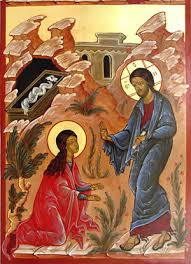
In John’s gospel account of the resurrection, Mary Magdalene goes alone to the tomb to finish the burial preparations interrupted by the Passover and sees that the tomb is already open. Keeping to the custom of her culture, Mary does not enter the tomb, but runs back to fetch Peter and John, who is the disciple Jesus loved. Mary, whose spiritual eyes had not yet been opened to the truth of the resurrection, informs the men that Jesus’ body was not in the tomb, supposing out loud that someone must have stolen it.