Thursday, April 6, 2023

Maundy Thursday, 2023: Putting our lives where our beliefs are

Lectionary: Exodus 12:1-4, (5-10), 11-14; Psalm 116:1, 10-17; 1 Corinthians 11:23-26; John 13:1-17, 31b-35  


En el nombre del Dios que es Trinidad en unidad. Amen. 

Do this in remembrance of me.

Did Jesus actually say those words which we repeat every Sunday in our Holy Eucharist? Maybe. Paul thinks he did. Whether he said them or not, Jesus’ own tradition was big on remembering, therefore, so is ours.

It’s important for us to remember that ours is a Judeo-Christian tradition, one in which the grand love-story of God and God’s people begins with the Jewish people. That love narrative continues in them as Jews, and, thanks to Jesus, it continues in us too as Christians.

The revelation that we are God’s people and that our salvation is from God, came to us through the Jews and was always meant to reach all nations and all peoples, as Isaiah and other prophets proclaimed. This revelation was never meant to obliterate one group in favor of another. Just as parents can love more than one child, God loves all of the branches on God’s family tree.

Priest and theologian, Verna Dozier once said, “The ancient Israelites were a people of cultic memory, and in song and story and liturgy they kept that memory fresh. It was their memory of special events that had shaped them… The memory included the interpretation of these events that… had a special place in God’s plan. ... [they] began with the big picture — faith in a God who acted on their behalf.”

These forebears of our faith created a ritual designed to help the generations that follow remember God’s deliverance of the Israelites from slavery to freedom. Held in the Spring, the celebration of Passover signals rebirth and renewal. The seder meal, (seder meaning order) which begins the Passover celebration, unfolds in four parts marked by four cups of wine consumed during the meal which includes ritual actions like hand-washings, prayers, and hymns of praise. It’s very beautiful.

The first part of the seder meal is the telling of the story (called the Haggadah), and it focuses on the children who are asked four questions, beginning with “What makes this night different from all other nights?” The question is meant to encourage the children to ask questions and spark their curiosity. This is how Jewish children are taught about their faith and their identity as children of God.

The second part is drinking the four cups of wine. Each of the cups represents how God has acted to save and is taken from the book of Exodus (6:6-7). These four acts are: “I will bring out," “I will deliver,” “I will redeem,” and “I will take” and they occur at specified moments in the meal.

The third part is eating symbolic food. Roasted lamb symbolizing sacrifice, Matza referred to as poor persons bread together with parsley or other bitter greens that symbolize the bitterness of being enslaved. The greens are dipped into water that is salted, symbolizing the tears of the people enslaved by the powers of the world. There are many more and they are fascinating, so I encourage you to go to our website and read the teaching about this posted on our Christian Education page. There are also links to Jewish sites there. Passover is, after all, their holiday.

The fourth part is about hope - trusting the freedom given to them by God and looking forward to the future God has planned for them. The Jewish people acknowledge that though we live in an imperfect world, the day will come when spiritual perfection is achieved. They repeat a familiar refrain for this hope: “Next year in Jerusalem.” 

It matters that we know this and that we, who are not Jewish, don’t appropriate this holiday. It’s enough for us to know how we are connected to it – and we are connected in a very significant way.

Remember that I mentioned the four cups. Let’s look carefully at them. 

The first cup is the cup of SANCTIFICATION. God says: “I will bring you out.” To sanctify is to set someone or something apart as holy. The people of God are “chosen” by God. God will bring them out from their slavery so that they can serve God, not a human master.

The second cup is the cup of DELIVERANCE. God says: “I will deliver.” Only God can save. We cannot save ourselves. The temptation most of us face is spending time and energy trying to do the right thing or to live the right way, in order to earn salvation. But that isn’t possible, because, as we know, salvation is a gift from God. We can’t and don’t earn it.

The third cup is the cup of REDEMPTION. God says, “I will redeem.” In the Jewish tradition the word redemption also means “avenger of blood” and it is, by definition, a family member. This family member acts to set their kin free from slavery, paying a ransom, or great price for that freedom. The traditional image is of a father sacrificing his firstborn son for the freedom of his entire family. Sound familiar?

At dinner with his friends, Jesus claims himself to be this third cup. It is his blood, his life that will be given for the redemption of all by the forgiveness of sin. Because he is fully God and fully human, Jesus is the Father who pays the price, the Son who is the price, and the family for whom that price is paid.

The fourth cup is the cup of HOPE... hope for the future. The Jews understood this to be the cup of Elijah, for whom an empty seat is kept at the seder table. The filling of that seat would signal the coming of the Messiah. Jewish theologian, Tim Hegg says that, for the Jews, “redemption guarantees the final destination, but the journey is still necessary.”

The same is true for us as Christians. The Messiah has come so our final destination - reconciliation of the whole world to God in Christ - is guaranteed. This is not about where we go when we die but about how we live in the world. The journey is still necessary, and we participate in this journey by doing our part in the continuing reconciling work of Jesus until the whole world is reconciled to God.

That brings us back to the mandate: to love and serve one another as Jesus loved and served us – with a towel around our waist, in humble service to all. “I have set you an example, that you also should do as I have done to you.”
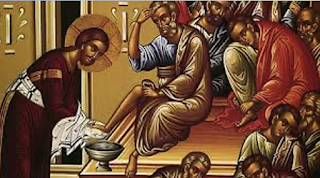
To make this crystal clear, Jesus put this new approach into the form of a commandment – a mandate (which is the root of the word ‘Maundy”): “Just as I have loved you, you also should love one another. By this everyone will know that you are my disciples, if you have love for one another."

Maundy Thursday reminds us to put our lives where our beliefs are and make manifest our commitment to be followers of Jesus Christ. As the church in the world today, it is our duty to live as servant leaders in the pattern and practice of Jesus. God grant us the will to put into action what we believe in our faith.

I close with a prayer I wrote about servant leadership. Let us pray...

Fill us, most merciful God, with the power of your Holy Spirit, and free us from any bonds that continue to restrict our freedom to fully love you, one another, and ourselves. Enter our dreams each night and show us your will for us as your church’s servant leaders in this time and place. Loosen our tongues to speak your truth. Strengthen our hearts to birth your love into reality no matter the cost; and make each of us to shine with the celestial light that is the mark of your saints in heaven and on earth; for the love of your Son, our savior, Jesus, the Christ. Amen. 


Links to Jewish sites for their teaching on seder meals: 


Sunday, March 19, 2023

Lent 4-A, 2023: Peace, assurance, Laetare!

Lectionary:1 Samuel 16:1-13; Psalm 23; Ephesians 5:8-14; John 9:1-41 


En el nombre del Dios: creador, redentor, y santificador. Amen. 

Today is Laetare Sunday. Laetare means “rejoice!” What do we rejoice during Lent? The answer is in our Scripture today.

In the Old Testament reading, we hear a call to wake up, to stop looking back at what was. I know you grieve the loss of it, God says to Samuel, but look, I am sending you a blessing, a leader who will bring you forward into the life I choose for you, a life of peace and abundance, a life so tenderly described for us in the 23rd Psalm.

When we listen prayerfully to this Psalm a deep calm begins to happen in us. Our breathing slows, our faces relax, the knots in our stomachs and chests release. We breathe in - filling ourselves with the grace of God, and we breathe out, releasing all our stress.

Now enveloped in divine peace, we notice that a beautiful table has been set for us, but not just for us. Also present are those who trouble us, but the divine peace within us keeps us from judging or questioning or excluding.

We sit together at tables covered in fresh, white linens. The flames of the candles on the tables dance in the soft breeze but never go out, and on the tables are vases of fragrant flowers and herbs.

Sumptuous food is in the center of each table; and there are goblets of water and wine, already full, at every seat. It’s a family meal where no one is left out of the conversation, and everyone has plenty to eat. Our cups are running over, and joy abounds.

Then, to prove just how much we matter, God anoints our heads with oil - something usually reserved for kings and queens. At that moment, when the oil touches our foreheads, we feel the power of God’s love enter us and course through our bodies like light breaking into darkness. The anointing reveals to us that we have been chosen by God to lead others to this gracious place where all are made one in the family of God.

This inclusiveness in the family of God is what Jesus is demonstrating in today’s gospel from John. The man born blind would have been judged by his village as cursed, his blindness from birth a punishment for sin. Jesus reframes this saying, yes, this man was born blind, but it is you who have judged him as sinful and unworthy, and you who have excluded him from your community. Wake up and see how through him the graciousness of God will be revealed.

Then combining the dust of the earth with the life-giving water of Christ’s own self, Jesus anoints the man and tells him to go and wash in the water called “Sent” (Siloam). As he does this, the man’s sight is restored.

By restoring his sight, Jesus also offers the man a whole new future. He has the potential for a job, a family, and to be restored to his community. His days as a vilified sinner are over - or are they?

The gospel story tells us that his community’s response to his restoration was yet more judgment. His community and their leadership doubted all of it, and eventually cast him out – again! Why? 

At our Bible study a wise parishioner mentioned fear, which reminded me of an old Jewish saying attributed to Rabbi Baal Shem Tov, the founder of Chassidic Judaism, who said: "Fear builds walls to bar the light."* The reason is, the light can be challenging because it reveals truth to us – God’s truth, not a truth we concoct to comfort and affirm ourselves.

There were plenty of stories floating around in that time about miraculous healings where a person's sight had been restored, but this healing is different because this man's sight was created. When Jesus made mud from the dust of the earth (think about Genesis here) and wiped it on the man's eyes, he was doing what only God can do - creating something out of nothing.

This event shook all who witnessed it to the very core of their beliefs. It took them beyond their small, certain concepts about God and salvation, and left them confused and fearful as they tried to work out the conundrum they faced: such a healing could only have happened by the power of God, so Jesus must be from God. But the healing happened on the Sabbath, which violates the law of Moses, which means Jesus is a sinner…

The people eventually went to their religious leaders for an answer, but they also were unable to resolve the conundrum. Instead, the Pharisees shift their focus to reviling the man who was healed. He was, after all, a nobody, a beggar, whose blindness was a sure sign of his sinfulness. How dare this sinful nobody challenge the certainty of their beliefs! So, they drove him out. Problem solved. Except it wasn’t.

Hearing about the man's excommunication, Jesus finds him and asks him: Do you believe in the Son of Man? Probably unsure about any of his beliefs by then, the man asks for help from his healer: Tell me so that I may believe.

Jesus' response to him is so amazing: You (who were blind) have seen him… and the man gets it (spiritually and actually), crying out, Lord, I believe! Suddenly, the one whom the people unjustly excluded is graciously included by God.

The scary part of this story is that last bit, where Jesus proclaims a truth many of us don’t want to hear. For those who are ignorant of God, their blindness is not sin, but for those who profess belief in God, ignoring the way of God is sin. 

Sin is not the bad things we do - those are the evidence of our sin. Sin is a state of separation from the wholeness of God which leads to disharmony with one another.

The blind man’s community judged him as unworthy, a sin later repeated by the Pharisees. Only God can judge, and God’s judgment is always yoked to God’s mercy. As is clear in this story, ours is not.

Breaking community, casting out members of the family of God, is also sin. This is what the Pharisees did by casting out the healed man who had been born blind. The Pharisees and all of us who have received the opportunity to “see” know better than to repeat those sins.

It’s no easier for us in our time, however, than it was for the Pharisees in their time. If you have ever unjustly judged someone or cast them out of your lives (in the absence of abuse), raise your hand… No don’t! It’s a rhetorical question!

I'd like to close with a story about fear, friendship, and faith. Once upon a time, a woman was on a hike
with a group of friends. The place they planned to stop for lunch brought them across the crest of a small mountain peak. Just past the rocky crest, was a clearing where picnic tables allowed hikers to enjoy a magnificent view of the valley below.

As the woman stepped onto the crest, she looked up and saw a rock ledge jutting out into the sky. Suddenly, she lost her sense of where she was. There was nothing for her to hold onto, no wall to lean on, and she found herself paralyzed, confused, and very afraid.

She truly believed that if she tried to take a step, she might fall off the edge of the mountain. Seeing her friend unable to move, another woman in the group took her hand, and spoke to her, gently reminding her to look down at her feet.

Seeing that her feet were safely on the ground, the woman breathed a sigh of relief. Her friend continued to speak to her, asking her to trust her as she led her across the crest to the other side where their lunch was waiting on the picnic tables.

She did. And she said no lunch ever tasted as good, and no vista ever looked as beautiful as that one did that day.

We are children of God and so, we have nothing to fear. God will always provide a hand to lead us and a voice to speak the words that will center and ground us. And God will always lead us to a peaceful place where a table is already set for us.

Then, having been fed, we are sent – because we have seen him, and we believe! As a community of faith, bound together by the love of God in Christ which lives in us, as we live in him, we are assured of God's promises of forgiveness of sin, abundant grace, and steadfast love, so we can move forward together with confidence into whatever future God is leads us to, today. 

Laetare! Rejoice! Amen. 

*Baal Shem Tov, Reprinted from A Treasury of Jewish Quotations, edited by Joseph L. Baron, Jason Aronson, Inc. 

Sunday, February 26, 2023

Lent 1-A, 2023: Led by the Spirit

Lectionary: Exodus 24:12-18, Psalm 99; 2 Peter 1:16-21; Matthew 17:1-9 


En el nombre del Dios: que es Trinidad en unidad. Amen.

Welcome to my favorite liturgical season! The deep, dark, transforming beauty of Lent is very simply this: learning and practicing being led by the Spirit to the Spirit.

Matthew tells us that Jesus was tempted by the devil, diabolos, the disturber of our connection with God. This is not a red demon guy with a tail and pitchfork who is nearly equal in power to God and spends his time trying to trick believers away from God. In our discomfort over our own innate propensity for evil, we humans have projected that onto an outer character from whom we think we can disassociate.

The diabolos, the disturber of our connection with God, can be within us, e.g., those inner voices that mollify our guilt as we justify our decision to sin. It can also be outside of us – as Peter was when Jesus had to tell him, “Get behind me Satan. You are a stumbling block to me; for you have your mind not on divine things but on human things.” (Mt 16:23)

In his letter to the Romans, St. Paul says all people sin. How he explains that isn’t a shining theological moment for Paul, imho, but his point is well taken. We all sin, so how we understand sin matters. We simply must get beyond the childhood concept of sins being bad things we do and go behind those to what motivates us to do them. That is where we find our diabolos.

When we do that, we have the ability to see ourselves in truth and claim our salvation as the gift it is. As St. John Chrysostom once said, “Let no man mourn that he has fallen again and again, for forgiveness has risen from the grave.”

It's important to note that in our gospel story, Jesus was led by the Spirit into the wilderness. This is a story describing Jesus’ discernment. Was he ready and was the world ready for Jesus to begin his ministry in the world?

This also may be the most comforting phrase in Scripture this season. God had a plan for Jesus just as God has a plan for each of us, and it is always a plan of love and redemption. God is leading us exactly where God was leading Jesus, not into temptation, but into a life transformed by our connection to the Spirit of God, a connection that will transform the world.

The temptations are present because that is the human condition and because we have free will in our relationship with God. Will we choose to be led by the Spirit into an unknown, possibly painful moment trusting God’s loving plan for us and the world, or will we choose not to enter, remaining where we are? The choice is always ours to make.

When we choose to be led by the Spirit, we know that we will see the truth about our own fragility, mortality, and all the other things about ourselves we often work hard to ignore or deny. That’s why Lent is often experienced as painful and depressing – because we confront the truth that we’ve led ourselves to believe in a version of ourselves that is comfortable but isn’t the whole truth about us.

Jesus opens that truth up in his three temptations: being self-centered, self-doubting, and self-serving. The one who came among us and gave up his whole self for us was as tempted as we are in his humanness. That’s why this story is so important because, by it, Jesus is showing us that as we face the temptations every human faces, the voice of God will speak to us from within as it did for him.

Please notice that at no point in this story do we hear Jesus straining as he did in the Garden of Gethsemane. Jesus didn’t need to fight or resist the temptations he faced. He simply needed to hear and heed his inner voice, which is the divine voice, that revealed the way for him to go. Our purpose during this season is to learn to hear and heed that same divine voice within us.

In the first temptation, Jesus had to confront his self-centeredness. His bodily hunger made him the center of his thoughts and attention. But the temptation of hunger goes beyond the stomach and into the soul.

Most of us know that some hungers can drive us to terrible decisions if we let them, hungers like the over-consumption of food, drink, or things that don’t satisfy… self-hate that projects out and does harm to others… fear that kills whatever threatens our sense of security – even when those threats are other people, innocent people. Trayvon Martin an unarmed, black teenager shot to death as he walked around his family’s neighborhood, and Breonna Taylor, a black woman asleep in her bed when police busted in and shot her, come to mind here… or the hunger to be important, noticed, or acclaimed.

Which leads to the second temptation: self-doubt. Are we truly worthy of God’s love, mercy, and salvation? Do we need God to prove it on our terms or would we accept it on God’s terms – as a core truth about divine grace?

With self-doubt, there is always the conjunctional temptation of self-importance. Wasn’t Jesus so important that all of heaven and earth would tend to him if he wanted it? For us, this is a classic story of the temptation of privilege. Jesus could have stopped the whole wilderness thing with a word, a divine word, but that would have made him the object of the salvation he came to bring.

Which leads to the third temptation: being self-serving. Jesus, the Christ, didn’t come among us as a King or military power like David. He came as a baby and served as an itinerant preacher whose ministry was by all earthly measures, a failure, as he ended up accused of sedition, tried, and executed. That’s because his ministry wasn’t about him or his success but about us and our successful connection with God. His was the quintessential ministry of servant leadership that we all strive to emulate today.

So, how does all of this relate to our temptations, our ministry in the world, and our Lenten experience?

Jesus was led by the Spirit. So must we be. Jesus was tempted. So will we be. The Spirit led Jesus through temptation, not into it, staying with him and speaking to him all along the way.

In the moment of his temptation, Jesus didn’t fight or exert his human or divine will to get through. He simply allowed the words of God to happen within him and show him the way to go. Likewise, our goal in Lent is not to exert our will but to relinquish it, to let go and be led by the Spirit to the Spirit.

With each temptation, Jesus “heard” a Scriptural quote come into his mind. When we confront the temptations in our lives, we too will hear the words of God come into our minds. Of course, that means we must be spending time in worship and Christian Formation, learning the words of God, the character of God, and the way of God, so that when the inner conflict happens, our preparation can bear this same fruit in us.

The season of Lent invites us to learn and practice being led by the Spirit to the Spirit. May we choose to go on a deep, dark, transforming, journey into ourselves, knowing that we will find God there already loving us, offering to guide, comfort, and make us ready to serve the world in Jesus’ name. Amen.

Sunday, February 19, 2023

Epiphany Last, 2023: Guided beyond our limits

 Lectionary: Exodus 24:12-18; Psalm 99; 2 Peter 1:16-21; Matthew 17:1-9 

Mountains, clouds, devouring fire, and dazzling light. There is so much symbolic language and drama in our gospel today! God's self-revelation to humanity is always dramatic, whether it's to Moses, the disciples, or us. This particular revelation is also a first. God has never revealed God’s self like this before or since. 


In today's gospel, Jesus leads Peter, James, and John up to a high mountain – the traditional location where

God is met and heard, as we saw in the reading from Exodus. Suddenly, their friend and rabbi begins to shine with a light so bright they couldn't look directly at his face. Jesus' dazzling white clothes and the brilliant aura emanating from him are traditional symbols for transcendence - the greatness of God, surpassing all created things, including humans.

The gospel writer is telling us that what happened on that mountain was an experience that goes beyond the limits of all possible knowledge and experience. In that transcendent moment, the veil between earth and heaven is lifted, and suddenly Moses and Elijah appear, and they are talking with Jesus. The two most powerful prophets in Jewish history, Biblical heroes who were long dead, are suddenly not dead, and not gone. They're right here and Peter, James, and John watch as their ancient heroes chat with their beloved rabbi.

Aware of the historical significance of this event, Peter offers to build a memorial (a traditional response to a moment like this) – but before he can finish speaking, he and the other disciples are overshadowed by the Spirit of God who takes the form of a cloud, just as on Mt. Sinai when Moses was given the tablets of guidance; just as Mary was overshadowed when she conceived the Son of God in her womb.

In today's story, however, what these disciples conceive is the beginning of understanding of a transforming truth – the truth that Jesus is not just another powerful prophet, great teacher, or miraculous healer. He is the Incarnation, The Son of God – fully human, fully divine.

Theologian Raymond Brown says that the transfiguration of Jesus on that mountain made Jesus "transparent to the apostles' gaze.” Seeing him glow in that unearthly light and hearing the voice from heaven claim him as Son and Beloved, the disciples now were beginning to understand what they hadn't understood before. They were becoming aware that all of their preconceived notions about Jesus, including their grand expectations of him as Messiah, suddenly seemed so limited, so small.

Overwhelmed, they fell to the ground, …overcome by fear. Then their gentle rabbi touches them and speaks peace to them saying: "Get up, and don't be afraid."

Opening their eyes, the world has returned to one they can comprehend. Jesus wasn't glowing anymore. Moses and Elijah were gone. The bright cloud of God's powerful presence was gone. It was just them again – Peter, James, John, and Jesus – on the mountain, alone.

As they begin their journey down the mountain to rejoin the others, the disciples are still in that groggy state of mind that happens when your brain is trying to make sense of something it can't. We can almost hear their unspoken thoughts: Did that just happen? Was it a dream? It couldn't have been a dream… can you have a group dream? Wait till we tell the others! Maybe they saw the cloud like the Israelites did when Moses was on the mountain. But Jesus warns them to tell no one about the vision until after the Son of Man has been raised from the dead.

The disciples' journey down the mountain marks the beginning of their new lives - transformed lives. The truth conceived in them begins to take root and grow.

The remainder of Matthew's gospel shows us how their new understanding is nourished and expanded by their teacher, Jesus, with lessons on forgiveness, the kingdom of heaven and who belongs to it, healing as a sign of the generosity and accessibility of God's grace, and the very difficult concept of servant leadership. They do as the voice from heaven commanded them: they alter their lives so that they can continue to listen to him.

It's a long journey for them. They constantly come up against the limits of their habits and thinking, and Jesus patiently guides them beyond those limits again and again. It is a comprehensive formation process, and it will be necessary to prepare them for the passion and terrifying crucifixion to come. It will also be necessary to sustain them after Jesus' resurrection as they go forth into the world baptizing and teaching in his name.

On this the last Sunday after the Epiphany, we begin our liturgical journey down the mountain and into the wilderness of Lent. During this season, we intentionally set aside time to confront the limits of our own habits and thinking as we make space in our busy lives for Jesus to guide us beyond our limits.

One of the limits we modern Christians constantly confront is our individualism. Throughout Scripture we hear about God's people, God's salvation of the whole world, and yet, we go about our lives as if salvation is about me, not us. But, as we hear in the second letter of Peter, the good news, the prophetic message we share is for everyone and lives in us - men and women moved by the Holy Spirit.

Another limit we are compelled to confront as we live into Black History month is our place in the shameful history of the enslavement and oppression of other humans. We, sitting here, didn’t do that and never would, but we continue to benefit from our forebears who did. In addition, part of our privilege is the ability to not know, and therefore not act, to ensure that the dignity of all people is respected in our world today.

Did you know, for example, that even today, “If you own a home in St. Louis or St. Louis County, there is a good chance you will find—buried in the legal paperwork that came with your house—a document... [with] a title like “Conditions and Restrictions” or “Uniform Restrictive Agreement,” [which] may… include the provision that the owner cannot “sell, convey, lease, or rent to a negro or negroes,” or that “no lot in this subdivision shall be sold to members of the African race.” Source. I checked my house deed and I encourage you to check yours.

I have linked samples of these below along with some articles, including one from the History Channel describing how these “discriminatory governmental and market-based practices stacked the deck against… African American home buyers for much of the 20th century, keeping them confined to decaying urban neighborhoods.” 

The important thing to know is that even though these discriminatory racial covenants violate the federal Fair Housing Act of 1968, they remain to this day on the books as law in Missouri. We can change that – and the Webster Groves clergy association, of which I am a part, is working on it now. If you’re interested in joining this effort, please let me know.

On a recent trip to Ghana for a meeting of the Anglican Consultative Council, the Archbishop of
Canterbury, Justin Welby, said, “Our response must begin on our knees in prayer and repentance. … But our response does not end there. We are called to transform unjust structures, to pursue peace and reconciliation, to live out the Beatitudes in big ways and small.” Source

If we, like the first disciples, are to be made ready to be bearers of the Good News, we must allow ourselves to be guided by Jesus beyond all of our small, comfortable conceptions about God, ourselves, and our world. We must allow ourselves to be guided beyond the limits of our current understanding and experience. We must be willing to go down the mountain, work to transform unjust structures, and alter our lives, as men and women moved by the Holy Spirit so that we can serve faithfully for the glory of God and the welfare of all God’s people. Amen. 


Links for more information: 

https://www.history.com/news/racially-restrictive-housing-covenants 

https://ehocstl.org/restrictive-covenants/

https://www.npr.org/2021/11/17/1049052531/racial-covenants-housing-discrimination

Sunday, February 5, 2023

Epiphany 5-A, 2023: Living in Christ Consciousness

Lectionary: Isaiah 58:1-9a, [9b-12]. Psalm 112:1-9, (10); 1 Corinthians 2:1-12, [13-16]; Matthew 5:13-20 


En el nombre del Dios que es Trinidad en unidad. Amen. 

One of my favorite companions among in the communion of saints is St. Julian of Norwich who once
said: “For our soul is so deeply grounded in God and so endlessly treasured that we cannot come to knowledge of it, until we first have knowledge of God, who is the creator to whom it is united. For our soul sits in God in true rest, and our soul stands in God in sure strength, and our soul is naturally rooted in God's endless love. And all this notwithstanding, we can never come to full knowledge of God until we first clearly know our own soul.”

Knowing our own soul and our relationship to God and one another is what St. Paul is talking about when he says we have received the Spirit of God, so we must have “the mind of Christ.” Priest and theologian Jim Marion says: “For the Christian… the Way to the Kingdom of Heaven is Jesus Christ himself. (Jn 14:6) More specifically, it is ‘to allow God to transform us inwardly by the complete renewing of our minds’ (Ro 12:2) so that… ‘We have the mind of Christ (1Cor 2:16)… that is, the Christ Consciousness… which is the goal of the Christian path.” Source: Putting on the Mind of Christ (Hampton Roads, Publishing, 2011), xiii) Icon pictured: ©2005, Anne Pinkerton Davidson, Iconographer.

In Jesus, we witness how a beloved life lives in the world. No matter how the world reacted to him or treated him Jesus maintained a consciousness of love and mercy even forgiving his executors from the cross on which they hanged him.

Jesus showed us that Christ consciousness takes us beyond obedience to fulfillment of the law of love which forgives, restores, and reconciles all the world to God; and this is what Jesus is teaching in today’s gospel from Matthew.

Salt was a valuable commodity in the ancient world. In addition to salt’s unique ability to enhance the flavor of food, it was also used to preserve food, which often meant preserving life.

You are a commodity of great value, Jesus says. You are a preserver of life. And he followed that up with an equally powerful statement: you are the light of the world – something he said about himself…

When we hear this today, do we hear the power of these statements? Jesus says we are, not we will be, and not we could become… but we are a commodity of great value, “endlessly treasured” by God, as Julian of Norwich said, and the truth of this should radiate from us. As my other beloved companion in the communion of saints, Mother Theresa of Calcutta once said, “When you know how much God is in love with you, you can’t help but live your life radiating that love.”

The sad reality is that many people don’t know or experience this truth. The world is far too ready to make us believe that we are valued only if we have lots of money, beautiful bodies, or light skin. We are valued if we are social media influencers, the first ones picked to be on the team, or we walk a red carpet bathed in the admiration of others.

It seems true, but it isn’t. It’s an earthly trap, a temptation that leads us to bondage in sin. Henri Nouwen once said: “…When we have come to believe in the voices that call us worthless and unlovable, then success, popularity, and power are easily perceived as attractive solutions. The real trap, however, is self-rejection... [which is] the greatest enemy of the spiritual life because it contradicts the sacred voice that calls us the "Beloved." Being the Beloved constitutes the core truth of our existence.”

And that’s why we who follow Christ must let our light shine. We must radiate with the light of our Christ consciousness and the truth of our existence: that we are endlessly treasured and beloved of God.

But what do we do when we don’t feel like we’re endlessly treasured or beloved? When the world beats us down and we can’t hardly stand up much less radiate our belovedness we come to church where among our family of faith is someone who will be radiating the light of Christ for us. Standing near their light is enough to dispel our darkness and open our eyes and hearts again to the Christ consciousness.

We come to church and worship, because even when we can’t utter the words ourselves, even when we aren’t sure we believe a single bit of it, the prayers of the community uphold us like a life raft on the river of life.

Recognizing the truth of our belovedness as individuals is only the first step, but it leads to the second step: recognizing everyone else’s belovedness too. Over the past couple of weeks, we have experienced a communal trauma in the beating death of Tyre Nichols, another beautiful young black life lost to unjustified violence. The hardest part of this is that Tyre is only the most recent example. There have been so many more before him: George Floyd, Eric Garner, Michael Brown, Breonna Taylor, Stephon Clark. There are simply too many to name here, but each one was beloved, valued, and treasured by God, but not by our society - and the color of their skin had a lot to do with it.

As Stephanie Spellers, Canon to the Presiding Bishop, and an African-American woman, said in her recent reflection: “Even if brutality like this has happened before and will happen again, we need to sit with this particular incident. We need to sit and wonder why traffic stops so quickly escalate into police brutalization and then to tragic loss of life. Sit and acknowledge the depravity human beings are capable of when mob mentality kicks in. Sit and feel our own broken, haggard spirits, still raw from deaths too numerous to count… There have been other Tyre Nicholses, and I weep anticipating all the Tyres to come… Pray today that God will fill us with wisdom and courage, and move us to transform systems and hearts shrouded by evil, especially when those hearts might just be our own.” 

It is only when we all are willing to do that – to shine our light so systems and hearts shrouded by evil can be transformed - that we can be set free from the bondage of earthly blindness and look at ourselves and others with the eyes of God. Then we are living in Christ consciousness and as Nowen says, “Every time we encounter one another we are offered an occasion to encounter the sacred.”

The church must be a place where the truth of everyone’s belovedness is intentionally and even counter-culturally lived out. Every church’s mission is to shine the light of the truth of everyone’s belovedness until everyone believes it… and lives it… and glorifies God for it. Then we shall be called repairers of the breach, restorers of the streets we live in.

It isn’t our light we shine, of course. It’s the light of Christ. As I mentioned last Sunday, the world will often work to cover or douse that light in us. Our communion of saints is replete with martyrs whose light was so doused. But the light of Christ lives on and now it lives in us.

I close by reading our Divine Purpose statement, developed last year by your vestry. You can find this in your bulletin on the last page or on our website at the bottom of the Welcome page. This is how we currently commit to shining our light in the world:
WE BELIEVE that we are called to live in service to others following the example of Jesus Christ, our Savior, helping to heal a broken world by preserving God’s creation. As a Spirit-filled community of believers we welcome all to come as you are: LGBTQIA+, married, single, divorced, marginalized, from the youngest to oldest, exactly as God created you, regardless of where you are on the spectrum of faith or doubt. 
WE WORSHIP in community, in-person and online. We have a strong liturgical tradition grounded in the Book of Common Prayer with prayer and music that embraces diversity of spiritual life in this world. In our worship all people are welcome to receive Holy Eucharist at God’s table, and all are invited to participate as they are called and gifted. Our “prayground” reflects the importance of the presence of children in our worship. 
WE SERVE a broad community of people of all ages. In partnership with our local, national, and international neighbors, we serve all of God’s people learning from them and working with them toward true justice and equitable access to God’s bounty.
Shine on, Emmanuel. The bright light of Christ radiates warmly from you. Amen.

Sunday, January 29, 2023

Epiphany 4-A, 2023: Happiness-making partners

 Note: Today is also our Annual Parish Meeting day. 

Lectionary: Micah 6:1-8; Psalm 15; and Matthew 5:1-12 


Are you happy? That’s a loaded question, isn’t it? My mother used to ask me that after I’d screwed something up and the answer, of course, was, “No. I’m not happy.”

Being happy is a complicated thing, yet it is something we value so much it’s secured in our Declaration of Independence as an inalienable right. True happiness is an internal state of being not dependent on external circumstances, and it encompasses contentment, peace, satisfaction, completion, connection, joy, and bliss.

In today’s reading from the prophet Micah, the people have strayed from God, and they are not happy. It seems they have forgotten who God is and what God does, so God, who is also not happy, asks them to remember… remember how I brought you out of exile … remember how I redeemed you from slavery… remember that I sent you Moses, Aaron, and Miriam to comfort and guide you… remember how I brought you safely across the Jordan into the promised land. Remember who I Am and what I do for you.

Hearing this, they do remember, and they want to reconnect because they know it is only by reconnecting with God that they will have happiness. You’re right, God, they say. How can we make this right?

This is where Micah reaches his prophetic pinnacle: God has already told you: do justice, love kindness, and walk humbly with God. Such elegant simplicity and power in that statement.

Micah teaches us that God seeks an internal conversion from us, a shift in our attitudes toward God, ourselves, and the world. The question, then, isn’t what do we do, but what do we expect God will do?

This is what Jesus is teaching in today’s gospel. The context is this: Jesus has been going around Galilee teaching, healing people, and proclaiming the good news of the kingdom. He’s become a phenom. Huge crowds were following him everywhere he went, pressing in to get from him all kinds of physical and spiritual healing, and as the gospel writer said earlier, he cured them all. (4:24)

Our story picks up here. Another crowd is closing in, so Rabbi Jesus takes his disciples apart and sits down (as Rabbis do) to teach them.

This lesson, however, isn’t what it may seem at first. Theologian and Anglican Bishop NT Wright says, “If we think of Jesus simply sitting there telling people how to behave properly we will miss what was really going on… This is an announcement (Wright says), about something that’s starting to happen… It’s good news, not good advice.” (Matthew for Everyone, Part One (Westminster John Knox Press, 2004), 36.

What is the good news Jesus is announcing in the Beatitudes? That in him, in this moment and forever more, the kingdom of God is happening on earth as well as in heaven and everything is changed as a result. Then Jesus explains how this will work and it seems upside down and inside out – until we remember who God is and what God does.

Recently, a woman came to the church to ask for help with a car repair. Her request was outrageously high, and we couldn’t come close to giving her what she needed. Some of us were put off by her audaciousness and flabbergasted when she told us that our contribution wasn’t enough and demanded we do more.

This woman was simply asking for what she needed. Rather than blame her for our inability to meet her need, we should have thanked her for her courage in asking and for demanding that we do more because that made space for God to work. The woman was able to get her car repaired because our contribution, together with her portion, along with a gift from another church made it possible.

The transformation we experienced in that example is the same one Jesus is teaching his disciples: how to perceive and connect with those who are coming up the mountain to get what they need and how to make space for God to act in every circumstance. As Henri Nouwen once said, 
“Living a spiritual life requires a change of heart. Whether we are asking for money or giving money we are drawn together by God, who is about to do a new thing through our collaboration. To be converted means to experience a deep shift in how we see and think and act.”

In our world today there is war, unrelenting gun violence across our country, growing numbers of unhoused people struggling to survive winter, hunger, and the indignities heaped on them by so many. That is the way of the world.

The Good News is that the way of God is different. God’s way is a way of happiness-making, connecting us, and bringing us contentment, peace, satisfaction, completion, joy, and bliss no matter the external circumstances.

When we walk humbly with God, seeking justice and practicing kindness, the world will push back on us and those with the power to do so may try to harm or otherwise stop us from making God’s happiness happen.

It’s OK, God says, they do that to all my prophets. Stand firm. I will bless you, care for you, and protect you - and together we will not be stopped.

After our Holy Eucharist, we will gather for our Annual Parish Meeting and steep ourselves in God’s happiness as we celebrate our life as a church devoted to God’s way. Together we will remember who God is and what God has done for us, how God has redeemed us, cared for us, and brought us to this day. And we will give thanks that God continues to choose us to be happiness-making partners in the world. Amen.

Sunday, January 8, 2023

Epiphany, 2023-A: Thrilling moments of connection

Lectionary: Isaiah 60:1-6; Psalm 72:1-7,10-14; Ephesians 3:1-12; Matthew 2:1-12

En el nombre del Dios, que es Trinidad en unidad. Amen. 

I like today’s Collect, except for the part where it says, “we who now know you by faith” as if those who were in Jesus’ physical presence didn’t need faith to know him. That just isn’t so. Even Jesus’ closest disciples didn’t really know him as the Christ, the manifestation of the fullness of God on the earth, while they were with him. It took time and dreams and experience for them to get to that understanding.

The same is true for us. Knowing God in Christ comes to us with exposure (bring the little ones to church), experience, and the still small voice that speaks in our bodies and dreams. Jesus is present for us in real and manifest ways every day. With experience, we begin to notice just how true that is.

Our forebears speak in the Old Testament of not being able to see the face of God and live. We have seen the face of God – Jesus – and we still see it, literally and mystically.

Once when I was on a spiritual retreat, I was prayer doodling - which is a familiar prayer discipline for those who joined us at our recent Christian formation gathering on this topic. The image of the yoni came to my mind. The yoni is an ancient symbol for the divine womb, the procreative energy of God. Incidentally, this symbol is on all of our bishop’s seals and many diocesan logos. Isn’t that a beautiful notion?

Anyway, I was prayer doodling the yoni symbol using watercolors, with no real intention for the image. When I hung the paper up to dry and stepped back a little, I saw a bearded face which I recognized in my heart as Jesus. I was startled by the revelation. My heart was thrilled, as the psalmist says, and I laughed like Sarah as I praised God for this manifestation.

The manifestation of God to us is almost always like that – a surprise that thrills the heart. This is what Matthew describes in his telling of the Epiphany story. Upon seeing the child, Jesus, the visiting magi were overwhelmed with joy. In response, they paid him homage and offered him expensive gifts. Their hearts were thrilled by the manifestation of God they saw in Jesus – and they were Gentiles who had no expectation of the coming of a Messiah to save them.

Following their own tradition, these magi noticed an unusual star at its rising, signifying that an important person, a king, had been born. This is a reference to the ancient Eastern understanding of a king who was often called the son of God due to their importance. Some even thought that kings were gods or at least demigods.

So, these magi (however many there were – and it wasn’t three of them) followed the star, stopping in Jerusalem to ask for directions. Hearing about this Herod called the chief priests of the temple and the scribes to ask where this child could be found and they told him Bethlehem, according to the prophecy – which also said this child would be the ruler of the people, the shepherd – another word for king.

This sent Herod into violent paranoia again, which apparently happened a lot with him. Herod lied to the magi, asking them to return to him once they found the child so he could pay homage too. They didn’t. God spoke to the magi in a dream and told them not to return to Herod, so they went home by another road.

This, I think, is the crux of the story of the Epiphany. As one commentator said: Epiphany is “a celebration of the breaking down of dividing walls––the end of hostilities between groups of people (Eph 2:14). Epiphany challenges us to reconsider all the people whom we see as outside the pale––outside the boundaries of God's love. It challenges us to abandon our tribalism (racially, nationally, denominationally, etc.) and to expand our tents to welcome even those whom we would prefer not to love. It is a burning issue, because loving those outside our tribe is difficult––but Christ makes it possible. That is the Epiphany message.” (Dick Donovan)

The magi were outside the pale in those days. They were thought of as sorcerers who worked magic usingdemonic power and they would have been treated with suspicion, even contempt, by faithful Jews. Yet God tapped them on their spiritual shoulders and using their own traditional and spiritual understanding, sent them to find the Christ-child.

When they found him, their hearts were thrilled and they, like the shepherds in the fields before them,were overwhelmed with joy… for such is the lavish love of God, who brings down every boundary that limits inclusion in God’s love.

I want to point out that the magi did not get converted. They didn’t become Jewish proselytes, or get baptized, or change their religion. And God had no problem meeting them where they were, utilizing their religious understanding to connect with them and lead them to love.

How did they know Jesus? Was their understanding of this child-king like that of the Jewish people of the time? Is ours?

It is in this way: we all know Jesus as the manifest love of God who was, and is, and always will be. The magi’s encounter with Jesus was an experience of the love of God which thrilled their hearts and caused them to rejoice. There were no strings attached to their inclusion in Love, just as there are none for us today.

Any barriers we humans put up crumble in the face of the love of God in Jesus, and sadly, we still put up barriers. If you need help identifying them, just watch the news for a few minutes – you can’t miss them.

The first recorded smashing of a boundary in our Christian narrative was the one between Jews and Gentiles as St. Paul points out in his letter to the Ephesians: “…the Gentiles have become fellow heirs, members of the same body, and sharers in the promise in Christ Jesus through the gospel.” This was the start of a reconciliation cascade which is ongoing today.

Like Paul, we are also servants according to the gift of God's grace that was given us, and we are called to bring the good news of the boundless riches of Christ to anyone and everyone on the other side of one of our barriers. We are called to abandon our tribalism and expand our tents to welcome even those whom we have a habit or justification to exclude.

Each time the love of God is made manifest in our world, we are all in the presence of Jesus. Think of the many ways that happens: when a child smiles at us melting our hearts; when someone offers us an unexpected kindness; when a hymn or anthem lifts us to heaven; or when a sunset works us over like a work of art as Dar Williams says.

I’m willing to bet that we’ve all had moments that thrill our hearts and overwhelm us with joy. Honestly, one would be enough for a lifetime, but the love of God for us is so lavish that we get these thrilling moments of connection often, continually. 

All we need to do is learn to notice them and let them change us from glory to glory. Amen.